We may earn a commission from purchases through links in this article, at no extra cost to you. How we earn
Evaluation Methodology: This guide compares marketplace listings and supplied specifications without physical testing. No hands-on testing was performed. Evaluations rely strictly on advertised component manifests, manufacturer listing titles, and aggregated user feedback from retail listings.
Repairing modern multilayer smartphone logic boards introduces a direct spatial challenge at the workbench. Technicians operating micro-soldering irons and hot-air rework nozzles need adequate clearance beneath the optical head. Simultaneously, tracing broken circuit paths, bridging jumper wires across micro-passives, and inspecting solder joints require clear optical magnification without severe distortion.
Selecting a trinocular stereo microscope requires balancing zoom ratios, bench mounting styles, illumination, and camera sensor compatibility. Standalone optical heads suit technicians who already have mounting hardware, whereas pre-configured bundles advertise matched eyepieces or articulated boom arms. The following comparison highlights marketplace options to assist technicians in evaluating optical configurations for their repair bench.
Core Optical Heads: Continuous Zoom for Board Diagnostics
The optical head is the primary component in a micro-soldering workstation. Continuous zoom systems are widely listed for mobile device logic boards to allow smooth transitions from board-level component locating down to individual solder pads without losing the focal plane.
Mechanic Robot 6560T Trinocular Stereo Microscope
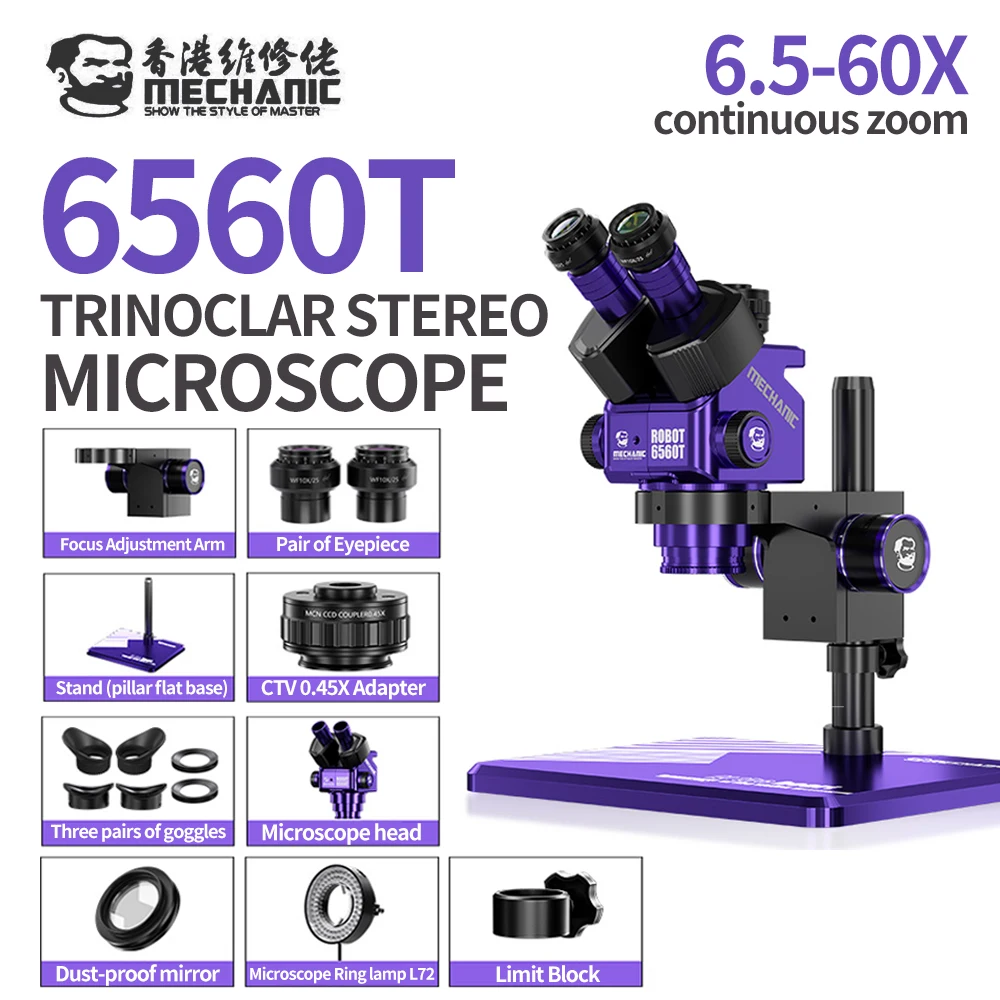
The Mechanic Robot 6560T is listed as a trinocular stereo microscope head intended for electronic repair, motherboard PCB welding, and fault detection. The seller advertises a continuous zoom magnification range of 6.5X to 60X. Its trinocular configuration incorporates an upright vertical phototube alongside twin angled ocular tubes to accommodate digital microscope camera mounts.
Target Use Case: This model is positioned for repair technicians who already own a compatible boom stand, illumination ring, and auxiliary lenses, and seek an optical head replacement or upgrade.
Practical Buyer Considerations: Listed at an approximate reference price of $254.29 (with a 4.9/5 marketplace rating across 181 reviews), the listing does not include a workbench stand, Barlow objective lens, or dedicated illumination. Because listing specifications are brief, buyers should verify what mounting collars, ocular guards, or adapters are supplied before purchasing.
Mechanic Robot 6560T-B11 Bundled System
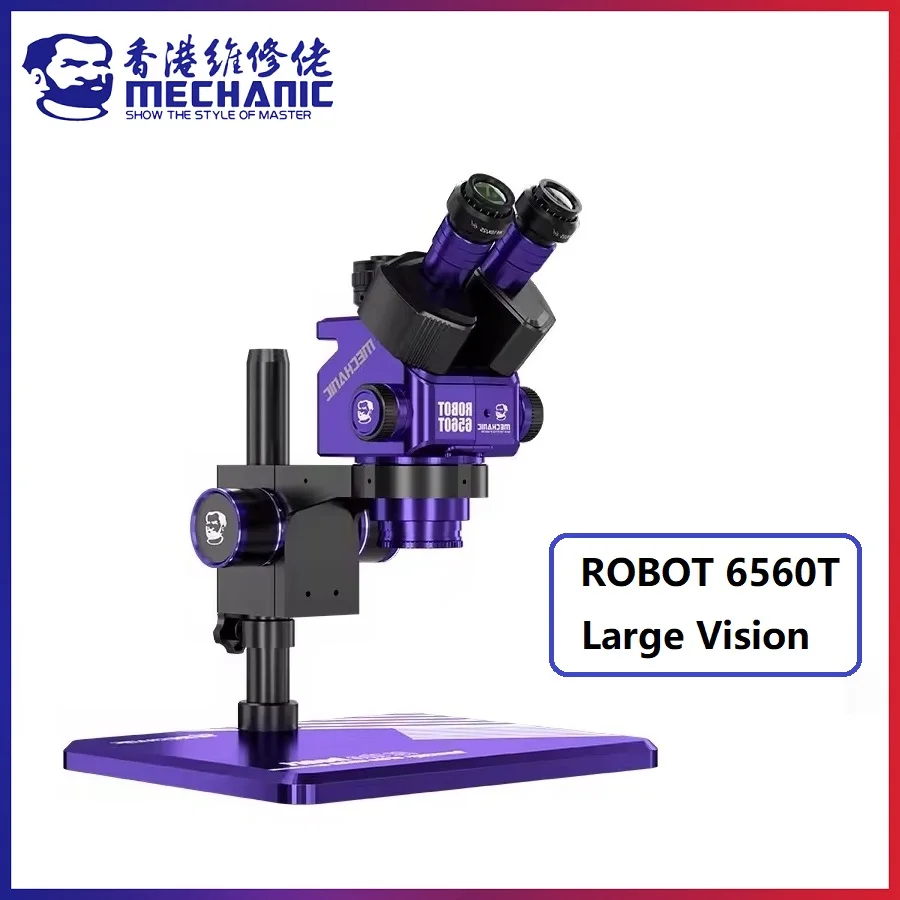
The Mechanic Robot 6560T-B11 listing pairs the advertised 6.5X to 60X continuous zoom optical head with specific optical accessories. The B11 product title specifies WF10X25 wide-field eyepieces and a 0.45X camera adapter designed for the vertical phototube interface.
Target Use Case: This package suits technicians planning to connect a digital camera sensor while retaining wide-field eyepiece viewing for micro-soldering diagnostics.
Practical Buyer Considerations: Priced at approximately $271.57 (with a 4.9/5 marketplace rating across 189 reviews), this bundle supplies optical adapters but does not include a camera sensor, stand, or ring light. Buyers should check the seller listing to confirm thread compatibility with their existing camera mounts and stand focus blocks.
Workbench Illumination: Contrast and Glare Management
Magnification requires balanced illumination to reveal surface defects. Highly reflective solder joints, copper traces, and glossy solder masks can create glare when lit unevenly. Standalone microscope heads generally lack integrated lighting, requiring an auxiliary light source.
Adjustable 144-LED Ring Light Illuminator Lamp
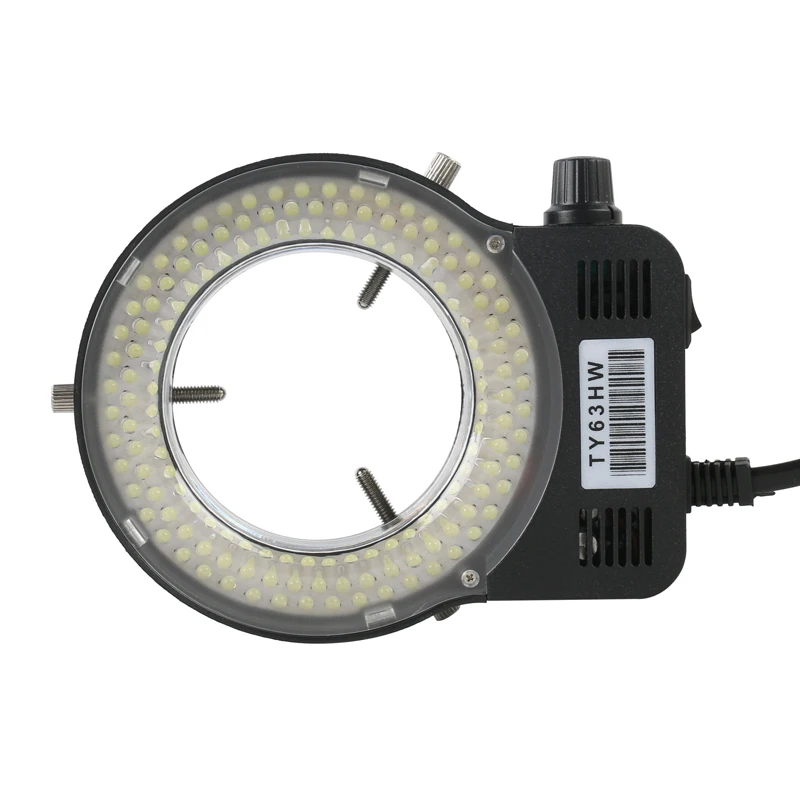
The Adjustable 144-LED Ring Light is listed as an accessory designed to mount around the objective housing of stereo trinocular microscopes, video cameras, and magnifiers. Advertised for dual 110V and 220V power inputs, it features 144 LEDs arranged in a ring to illuminate the PCB work area.
Target Use Case: This lamp is targeted at technicians building a modular microscope setup who need adjustable circular lighting for soldering and component inspection.
Practical Buyer Considerations: Available at an approximate price of $16.27 (holding a 4.8/5 marketplace rating across 144 reviews), the listing does not specify polarizing filters or exact ring clamp diameter ranges. Buyers should confirm the inner mounting diameter against their microscope's objective housing before ordering.
Integrated Mechanical and Digital Stations
Workstation packages combine mounting hardware, optical heads, and digital imaging hardware into a single listing, reducing the need to source separate mounting clamps and cameras.
RF4 Stereo Trinocular Microscope with 360° Articulating Arm and 4K HDMI Camera
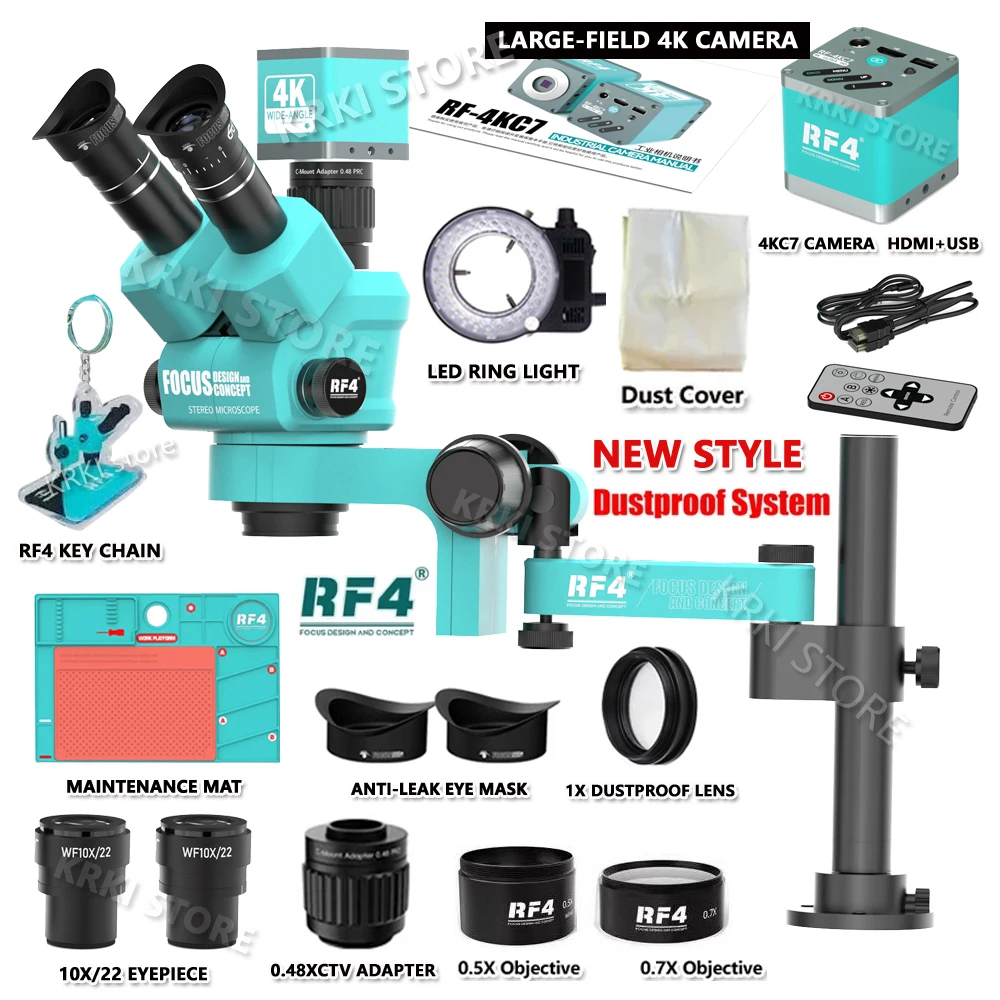
The RF4 trinocular microscope setup is advertised for phone soldering and PCB repair. Rather than relying on a fixed tabletop plate, the system includes a 360-degree rotating articulating arm stand designed to clamp to the workbench edge, alongside an advertised large-field 4K HDMI camera for monitor output.
Target Use Case: This package is aimed at technicians needing an integrated station with monitor output for customer demonstrations, shared diagnostics, or space-saving bench configurations.
Practical Buyer Considerations: Priced around $341.02 (with a 4.8/5 marketplace rating across 111 reviews), articulating clamp arms require a rigid workbench edge to minimize movement. Buyers should verify listing details regarding clamp maximum table thickness, included power supplies, and video cable accessories.
Technical Comparison and Selection Matrix
| Product Model | Role / Package Scope | Key Claimed Specifications | Reference Price (USD) | Target Workbench Application |
|---|---|---|---|---|
| Mechanic Robot 6560T | Primary Optical Head | Advertised 6.5X–60X continuous zoom; trinocular stereo optical head | $254.29 | Technicians upgrading an existing stand or building a custom workstation |
| Mechanic Robot 6560T-B11 | Primary Optical Bundle | Advertised 6.5X–60X zoom; WF10X25 eyepieces; 0.45X camera adapter | $271.57 | Technicians connecting a camera sensor who want wide-field eyepieces |
| Adjustable 144-LED Ring Light | Supporting Accessory | 144 LEDs; 110V/220V voltage support; adjustable brightness control | $16.27 | Add-on illumination for unlit stereo optical assemblies |
| RF4 Articulating Trinocular Setup | Supporting Complete Station | 360° articulating arm stand; 4K HDMI camera; stereo optical head | $341.02 | Compact repair benches requiring articulated clearance and monitor output |
Pre-Purchase Decision Framework
To avoid incompatible dimensions or unexpected omissions when ordering equipment for a repair bench, review these practical factors prior to purchase:
- Working Clearance Under Objective: Soldering with micro-tweezers and hot-air nozzles requires adequate vertical space between the PCB and the optical lens. Check the manufacturer's stated working distance on the listing, and verify whether auxiliary Barlow lenses are supported if extra vertical clearance is required.
- Camera Interface and Live Output: When selecting a digital setup for live micro-soldering, verify what video output interface is supported by the camera module (such as HDMI or USB) and whether display output requires dedicated software.
- Mounting Stability vs. Bench Space: Heavy baseplates provide rigid bench dampening but occupy surface space. Articulating boom arms clamp to workbench edges and swing clear when not in use, but require a securely anchored bench to prevent vibration at higher magnification.
- Listing Manifest Verification: Microscope listings on global retail platforms frequently display complete setups in promotional photos while offering several package tiers in drop-down menus. Confirm whether the selected SKU includes the bare head, eyepieces, camera adapters, or mounting hardware.